
Australia's Standards Framework Isn't Keeping Up With Your Car Stacker
Standards Australia published a paper in February 2026 that describes the exact structural conditions this industry has been living with for years — a standards framework too slow, too fragmented, and not designed for systems with long asset lives and safety-critical consequences. The major manufacturers are already positioning for what comes next. The gap between their new-product narrative and your existing installed asset has never been wider.
“Long asset lifecycles and safety considerations present particular challenges for circularity… performance-based standards are essential to balancing innovation, durability, safe reuse and lifecycle performance across materials and building systems.”
01 —
The Announcement Nobody in APS Noticed
In February 2026, Standards Australia published a policy insights paper. It was written for politicians, sustainability professionals, and industry peak bodies. Nobody in the car stacker or automated parking industry was in the room. But they should have been.
The paper is titled Standards Enabling Australia's Sustainable Transition. On the surface it reads like a document about carbon markets and recycling. But the structural conditions it describes — a framework that is often too slow to adapt, fragmented across multiple pathways, and not designed for systems with long operational lifecycles — map directly onto automated parking in ways that have gone entirely unnoticed by this industry.
Standards Australia's February 2026 paper does not address automated parking systems directly. But it describes the exact conditions that expose a growing gap in how these systems are governed. That interpretation is based on direct field experience across commissioning, fault investigation, and lifecycle performance of these systems.
I've been observing this gap in car stackers and APS for over a decade. What this paper does is provide the policy language that makes it harder for the industry to keep ignoring.
This changes things.
02 —
What the Major Manufacturers Are Already Doing
Before I get to what the standards gap means on the ground, let's look at what Wöhr, Klaus, and Lödige — the three largest APS manufacturers operating in our market — are actually saying and doing right now. Because some of it is significant, and some of it exposes the gap more sharply than anything I could write.
WÖHR — THE EPD MOVE
Wöhr has made the most concrete sustainability commitment of any manufacturer in this space. Their Parklift 450 is the first parking system in the world to receive an Environmental Product Declaration (EPD) — an independently verified, third-party certification that quantifies the environmental impact of the system across its full lifecycle. The EPD confirms a 95% material recyclability rate and a long service life as the primary sustainability metrics. Their Combilifts and Platforms are in the EPD certification pipeline.
They are also the only APS manufacturer to have had LEED and BREEAM project ratings confirmed on installed systems, and they're aligning their product range explicitly with EU taxonomy criteria for sustainable economic activity.
What this means for the article's argument: Wöhr has just created a formal, documented, independent lifecycle performance benchmark — for new systems. They have not applied anything equivalent to their existing installed base. The tens of thousands of Wöhr systems in operation globally, including in Australia, are operating without any equivalent independent verification. That gap is what Standards Australia is describing when they talk about lifecycle standards being absent.
KLAUS MULTIPARKING — THE E-PARKING PIVOT
Klaus describes sustainability as a "core engineering principle, not a feature." Their MasterVario systems now include their E-Parking platform, which supports EV charging on movable platforms — demonstrated in a recent Manhattan installation where 10 of 24 spaces are EV-charging capable. They're actively pursuing LEED advantages on new builds and citing long-term efficiency and durability as their core value proposition.
Their service language is interesting: Klaus maintenance teams are described as "knowing your system" based on maintenance history, and able to "assess whether and when renovation measures are necessary." That sounds like lifecycle awareness. But there is no performance benchmark, no independent standard, and no documented methodology behind that assessment. It is relationship-based, not standard-based.
What this means: Klaus is selling long-term durability as a value proposition for new sales, while the in-service standard for maintenance outcomes on their existing installed base remains undefined. The "we know your system" narrative is commercially useful but legally and technically unverifiable.
LÖDIGE INDUSTRIES — THE MOST ADVANCED NEW-SYSTEM CAPABILITY IN THE MARKET
Lödige was named World Market Leader 2026 in automated parking systems by WirtschaftsWoche and the University of St. Gallen — recognition they've held consecutively. Their RESPACE technology platform is genuinely impressive. Their E-PUZZLE system accommodates 100% EV charging on all pallets, includes grid-friendly dynamic load management, and is VDE certified and compliant with legal metrology standards. Their most recent US installation — a 31-storey Philadelphia residential tower — is the first fully automated parking system in America with 100% EV charging.
For new projects, Lödige includes comprehensive maintenance and 24/7 remote monitoring — as demonstrated in their landmark De Sax Rotterdam contract (916 apartments, completion 2030). That is a significant step toward what a performance-based service model actually looks like.
The critical gap: All of this capability is baked into new installations. Lödige has 80+ automated systems in operation globally, including installations in Sydney. Their public communications do not appear to address what happens to that existing installed base under EV load conditions, or whether those legacy systems are being monitored against any independent performance standard. Their new-product narrative is excellent. Their in-service legacy accountability is silent.
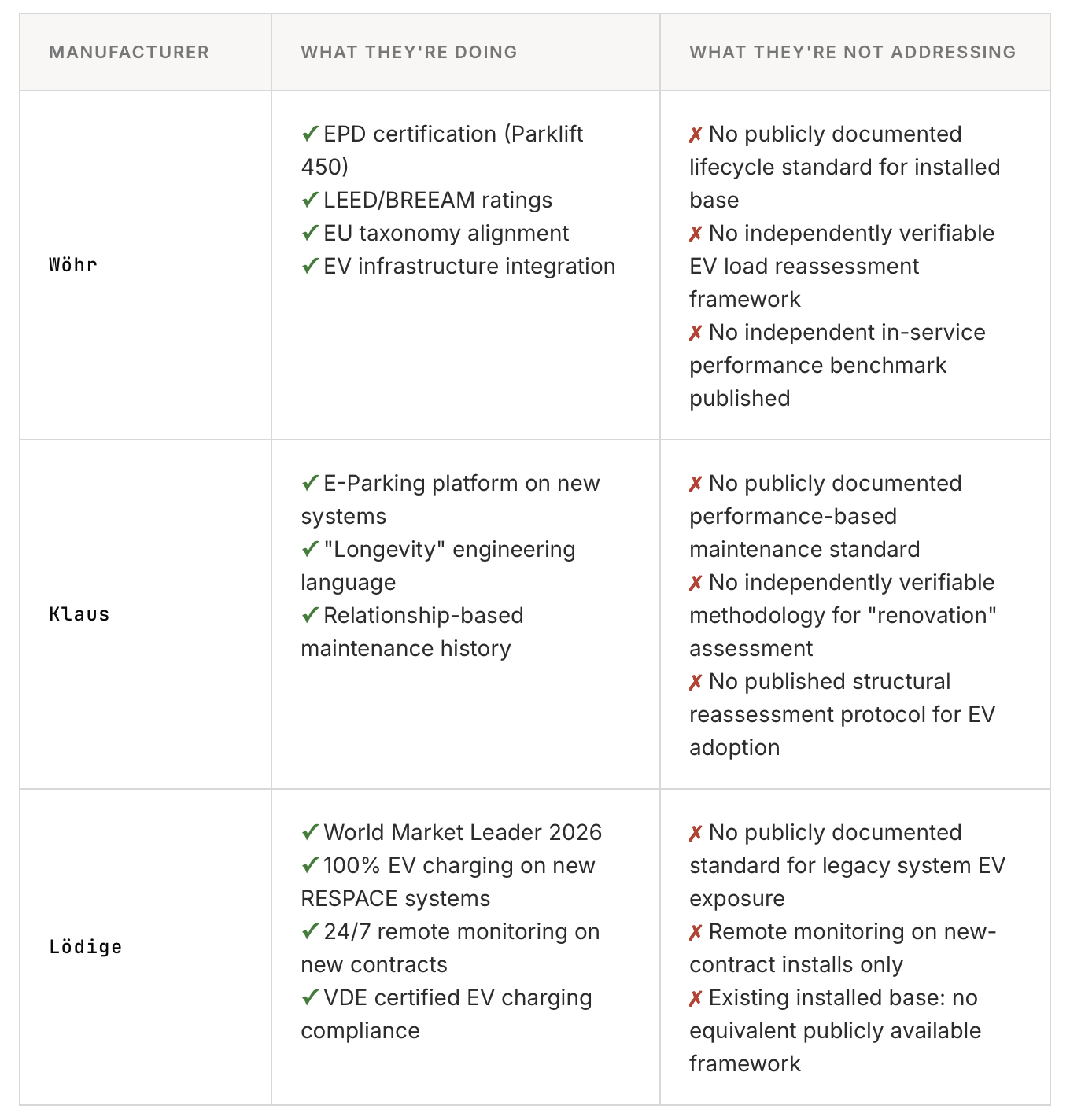
Read that table carefully. Every major manufacturer is investing heavily in making their new products sustainable, verifiable, and EV-ready. None of them publicly present an independently verifiable framework for assessing the performance of the existing installed base.
The manufacturers are selling the future. Your existing system is living in the past. And there is no standard in Australia that bridges that gap.
03 —
What the Standards Gap Looks Like on the Ground
Let's be precise about the present. I've seen this on hundreds of inspections, fault-trace reports, and maintenance audits across Australia and Europe. The problem isn't theoretical.
Australia has standards covering design, safety, and commissioning for parking facilities — including AS 5124 for mechanical car parking systems and AS/NZS 2890.1 for parking facility design. What remains far less defined is how these systems are governed across their operational lifecycle. There is no prescribed performance benchmark for what a maintained car stacker or APS must demonstrably deliver after five years of operation. There is no mandatory inspection interval tied to consequence of failure. There is no standard governing the load-rating reassessment process when an EV fleet replaces a petrol fleet in the same building.
FIELD REALITY
I have read maintenance contracts for APS systems worth $2–4 million that contain no performance standard whatsoever. The contractor is paid. The system is "maintained." And nobody in the building can tell you whether it will fail in the next 90 days. That is not a maintenance contract. That is a liability deferral document.
The NCC 2025 framework is accelerating EV infrastructure requirements in new residential buildings. That does not resolve how existing APS assets respond to increased vehicle weight and charging integration — and no current standard bridges that gap.
Gap 01
EV Weight — No Reassessment Framework
Modern EVs are often significantly heavier than the petrol vehicles many APS platforms were originally engineered for. No Australian standard mandates structural reassessment when fleet composition changes. The asset sits silently under conditions it was never designed for — until something fails.
Gap 02
AGV Systems — Wrong Code, Wrong Era
AGV parking systems are being commissioned under general electrical and building codes never written for AGV logic, emergency positioning protocols, or software-defined safety architecture.
Gap 03
Maintenance — Inputs Measured, Outputs Ignored
No standard defines what a car stacker must demonstrably perform after a maintenance visit. Contracts measure activity. None measure safety state. The two are not the same thing.
Gap 04
Parts Obsolescence — No Lifecycle Mandate
APS systems routinely outlive the manufacturer's parts availability window. No standard requires disclosure of obsolescence risk at point of sale or mandates a transition pathway when critical components are discontinued.
The absence of a standard is not protection. It is exposure. Because when there is no standard, there is also no defence.
What is missing is not more maintenance. It is independent verification of whether the system still performs as originally intended.
04 —
What the Future Looks Like — And When It Arrives
Standards Australia's February 2026 paper has not created this problem. It has published the policy language that makes it harder for the industry to keep ignoring it. The performance-based, lifecycle-embedded direction they're calling for across the built environment is not a 10-year horizon — the foundations are already being laid. The 43% emissions reduction target by 2030 is statutory. The Safeguard Mechanism is applying declining baselines to major facilities. The NCC 2025 framework is accelerating EV infrastructure expectations in new buildings.
The major manufacturers have read this. Wöhr's EPD, Lödige's remote monitoring contracts, Klaus's LEED positioning — these aren't marketing exercises. They're hedges against an accountability framework that is arriving. The question is whether the framework catches the existing installed base before the industry is ready for it.
Based on current field conditions, the policy trajectory I'm observing, and the signals coming from insurers and asset managers I work with, this is the direction I see the industry moving:
NOW — 2026
Insurance Underwriters Begin Asking Harder Questions
Already happening. EV-related structural load queries at renewal. Requests for current maintenance certification beyond standard visit logs. If your stacker has no verified performance record, your next renewal will be a conversation you're not prepared for.
2026 — 2027
Strata Reform Intersects With APS Liability
Owners corporations face increasing scrutiny on capital works planning and disclosed defects. Car stacker systems — often the single most expensive mechanical asset in the building — will appear on compliance checklists in ways they haven't before. Proactive disclosure will be rewarded. Reactive discovery will not.
2027 — 2029
Performance-Based Standards Enter the APS Space
As Standards Australia accelerates alternative development pathways for emerging technology categories, APS and AVP systems are logical candidates. Likely pathway: load rating methodology, maintenance outcome benchmarks, AGV-specific commissioning and safety protocols. Once a standard exists, ignorance of it is no longer a legal defence.
2029 — 2032
Lifecycle Accountability Becomes Contractual Norm
Developers embedding APS in new builds will face procurement requirements tied to demonstrable lifecycle planning. Institutional owners will require independent verification as a condition of asset sale or refinancing. The industry that has operated on trust and verbal assurance will be required to produce evidence.
2030+
Convergence With EV Infrastructure and Smart Building Standards
The intersection of APS, building energy management, and EV charging infrastructure creates a new technical domain that current standards don't address. AGV systems with integrated charging, dynamic load management, and remote diagnostics — the direction Lödige is already building toward — will require an entirely new framework. The organisations that helped shape it will have a structural advantage.
05 —
What You Should Be Doing Right Now
The window where proactive preparation is an advantage rather than a requirement is closing. Here is what I tell every client with an APS asset:
1. ESTABLISH A VERIFIED PERFORMANCE BASELINE
The most important step you can take right now is to get a truly independent technical assessment of your system — one that sits completely outside any manufacturer service report or maintenance contractor sign-off.
This assessment maps the actual, current performance state of your APS or car stacker against its original design specification and today's real-world conditions (EV weight loads, component age, obsolescence risk). It gives you a documented baseline — the single piece of evidence that proves you understood the risk and acted with due diligence before the new standards framework tightens.
Without it, you're still operating on assumptions. And as Standards Australia has now publicly confirmed, those assumptions are exactly what the system can no longer defend.
2. REVIEW YOUR MAINTENANCE CONTRACT FOR PERFORMANCE LANGUAGE
Pull your current maintenance contract and read it critically. Does it define what the system must demonstrably perform after each service visit? Does it set any safety-state benchmark? Does it address EV load changes? If the answer to any of those is no, you have an input contract, not a performance contract. That distinction matters when failure occurs and liability is being allocated.
3. UNDERSTAND YOUR EV EXPOSURE
If EVs are entering your building — or your strata rules don't explicitly exclude them from the stacker — you have a load management question that needs a structural answer. Not an assumption, not a conversation with the maintenance contractor. An engineering answer, documented, on record.
4. MAP YOUR PARTS OBSOLESCENCE HORIZON
Find out when the critical components of your system — control boards, hydraulic actuators, safety limit switches, AGV guidance hardware — were manufactured, and whether the OEM still supports them. A system that is 10 years old may have entered a parts sunset window without anyone in the building knowing. That is a capital planning issue, not just a maintenance issue. Wöhr's EPD work is relevant here: it signals that lifecycle documentation is becoming a standard expectation, even if the standard itself doesn't exist yet in Australia.
5. GET AHEAD OF THE INSURER CONVERSATION
Contact your insurer before renewal and ask directly what documentation they will require. Then produce that documentation from an independent source before they ask for it. The asset managers who are ahead of this conversation when standards arrive will be in a categorically different position to those who are reactive.
06 —
The Bigger Picture
Standards Australia's paper didn't set out to describe the APS industry. But the structural conditions it identifies — long asset lifecycles, safety-critical systems, a standards framework that hasn't kept pace — are precisely what defines this space. That paper has now provided the policy language that makes this gap harder for developers, insurers, and owners corporations to ignore.
In sustainability terms, that gap shows up in carbon markets and recycling systems. In APS terms, it shows up in buildings where multi-million dollar mechanical systems are operating on assumptions that haven't been verified in years.
The major manufacturers have seen this coming. Wöhr's EPD certification, Lödige's 24/7 remote monitoring contracts, Klaus's long-term durability positioning — these are not coincidences. They are early-mover positioning in anticipation of a standards regime that is arriving.
But here's what none of them are advertising: all of that capability applies to new systems. The existing installed base — hundreds of systems across Australia — sits outside every one of those frameworks. That is the gap. That is the liability. And it belongs to the owner, not the manufacturer.
Australia is moving toward a built environment where every major system is expected to demonstrate performance, not just existence. Where lifecycle thinking is embedded in procurement. Where the standard of care for asset owners is rising, steadily and irreversibly.
The standard is coming whether the industry is ready or not. The only variable is whether you're ahead of it or behind it when it arrives.
Not Sure Where Your System Stands?
Independent technical assessments and maintenance contract reviews for car stacker and APS assets across Australia. No manufacturer affiliations. No commissions. Just a field-accurate picture of what you actually have.